- Carbon fibers themselves are not susceptible to UV damage but the resin used to bond carbon fibers together can be damaged thus weaking over time.
- Cover carbon fiber composites with a UV resistant finish to prevent long-term damage from sunlight.
Category: Uncategorized
ELECTRICAL CONDUCTIVITY
- Carbon fiber is not a great conductor of electricity compared to metal. In fact, most metals conduct electricity around 1000x as well as plain carbon fiber.
- Even when treated with other materials, carbon fiber is still not quite as good as metal when it comes to electricity conduction.
EPOXY – How it works
- The remarkable strength of epoxy resin is due to its impressive molecular structure.
- Long chains of molecules in the resin structure form interlocking bonds with one another.
- These strong bond are responsible for epoxy’s extremely durable quality, as well as its resistance to tearing, scratching
- Epoxies are a type of plastic material that becomes rigid after a chemical reaction Epoxies consist of two parts: Part A, which is the epoxy resin, and Part B, the hardener.
- Epoxies consist of two parts: Part A, which is the epoxy resin, and Part B, the hardener
- Part A contains chains of molecules with epoxide groups, which are ring-like structures made of two carbons and an oxygen.
- Epoxide groups are spring-loaded molecules, ready to break apart when disturbed.
- Part B, the hardener, contains nitrogen compounds that are attracted to the positively charged part of the epoxide ring.
- When mixed, the hardener reacts with the resin, causing the epoxide ring to spring apart and allowing chemical units to link with neighboring units, forming polymers.
- The polymers continue to cross-link with each other, making the structure stronger and harder.
- The process of rings breaking and chains cross-linking thickens and hardens the mixture irreversibly.
CARBON FIBER COMPOSITE
- Most carbon fiber products we see and use are actually a Composite of Carbon Fiber fabric coated in Epoxy.
- Sizing is applied to the Carbon Fiber filaments during production and significantly enhances the Epoxies ability to bind to surface of Carbon Filaments.
- Sizing only contributes normally 0.5 – 5% of a filament weight.
- The composite material is both long Carbon Fiber filaments and a glue-like epoxy coating known as a “thermoset.”
- When curing, molecules in the liquid resin bind with each other around the woven carbon filaments, hardening into a strong and rigid lattice.
- This resulting Carbon Fiber composite is extremely lightweight and strong.
ARAMID & ARAMID HYBRID FABRICS
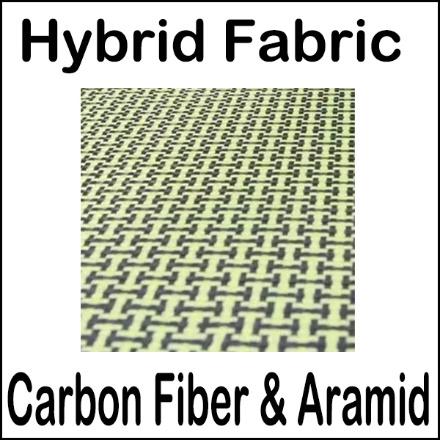
- Carbon Fiber Aramid fabric is often made from weaving Carbon Fiber fabric and Aramid fibre.
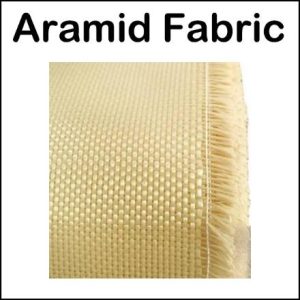
- Aramid fibres are made of aromatic polyamides and possess remarkably high Young’s modulus (strength) more than 20 times higher than conventional polyamide fibers. Aramid fabrics are synthetic fibers, known for being heat resistant and especially strong.
- Originally designed for the US military, this is a high-performance material which is favored for its extreme durability.
- Examples of Aramid fabrics are Kevlar, poly-para-phenylene terephthalamide also known as Kevlar
- This carbon fiber and aramid hybrid fabric combines the properties of both highly advanced fiber reinforcements. The carbon tow provides a very high level of strength and stiffness, while the aramid provides very good impact/abrasion/fracture resistance to the laminate layup.
Fabric Weight
- Carbon Fiber fabric weight is referred to as grams per square meter of fabric.
- For example a fabric that is 3K, 2×2 Weave 240 grams – means the fabric is woven using 3K TOWS (3000 filaments per bundle) in a 2 by 2 weave and 1 square meter weighs 240 grams.
- A fabric that is 600 grams per square meter will generally be a thicker heavier fabric usually with larger TOW of 6K to 12K filaments per TOW.
Spread Tow vs. Standard Tow
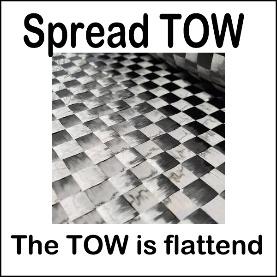
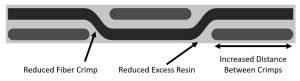
- Spread tow material can be a good compromise between using uni-directional material and standard woven material.
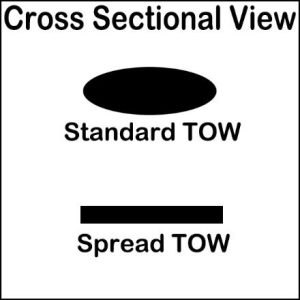
- Essentially the TOW is flattened into a broader thinner yarn.
- As a fiber tow weaves up and down to create a fabric, the strength is reduced due to the crimp in the tow.
- As you increase the number of filaments in a standard tow, from 3k to 6k for example, the tow becomes bigger (thicker) and the crimp angle becomes harsher.
- One way to avoid this is to spread the filaments out into a wider tow, this is called a Spread tow and there are a couple of benefits gained by doing this.
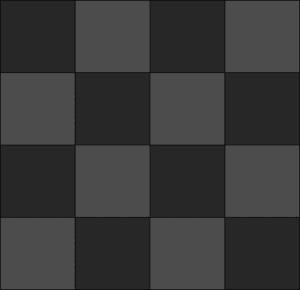
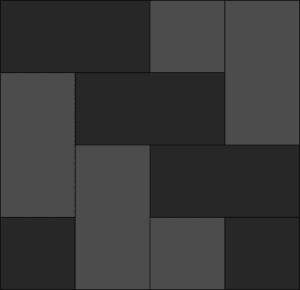
Exotic Weaves
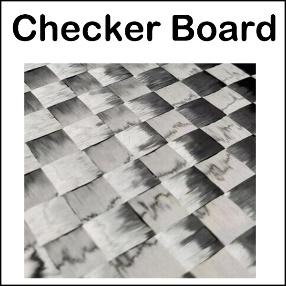
Carbon fiber fabric can come in any number of creative weaves for aesthetic or other reasons.
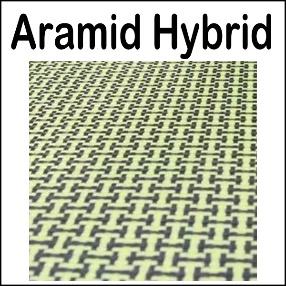
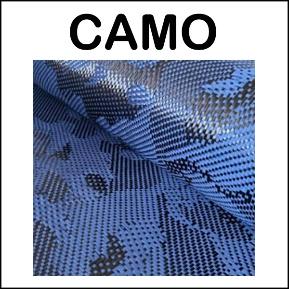
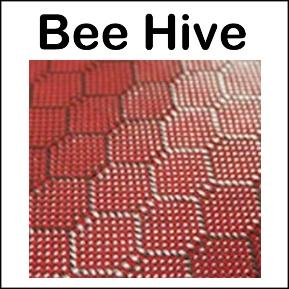
CARBON FILAMENTS
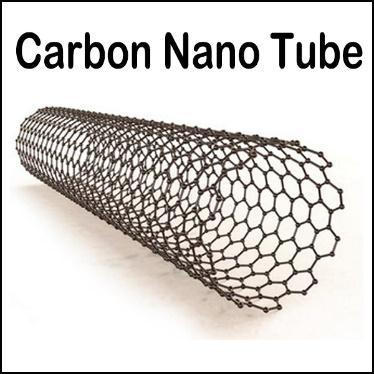
- Carbon fiber fabric is made of incredibly small diameter fibers (or filaments / nano tubes) made mostly of carbon atoms arranged in a helical structure.
- About 90% are made from polyacrylonitrile (PAN). The remaining 10% are made from rayon or petroleum pitch.
- These fibers (nano tubes) are extremely small, usually between 5 -10 microns in diameter (a micron is a millionth of a meter or about 0.000039 inches).
- These fibers usually are bundled to form thread (or tow) that often is woven into a fabric.